Home
Home PG College
 Patient Login
 Sancheti Clinic
 Contact Us
 Download Reports
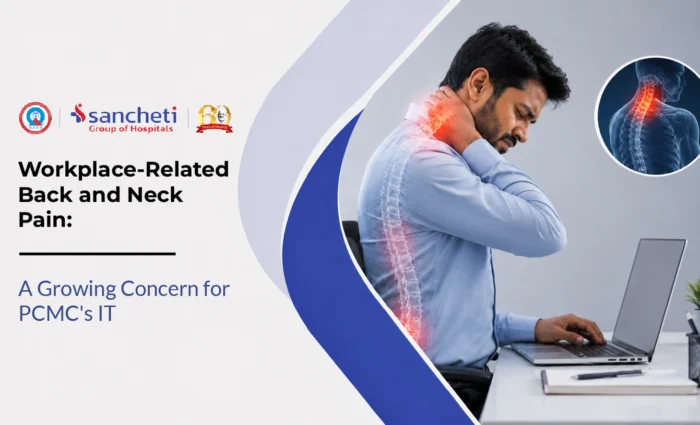

Workplace-Related Back and Neck Pain: A Growing Concern for PCMC’s IT Professionals
As PCMC in Pune has grown into one of India’s fastest-expanding IT and industrial hubs, long hours at desks, poor posture, and limited physical activity have made back and neck pain increasingly common among working professionals. What begins as occasional stiffness can gradually develop into persistent pain, reduced mobility, headaches, or even nerve-related symptoms.
Sancheti Hospital’s Spine Department in Pune addresses this growing clinical burden, providing spine care that spans ergonomic guidance, structured physiotherapy, and surgical intervention for cases that require it. This guide explains how desk work damages the spine, which conditions develop, and what the full treatment pathway looks like.
What Is Workplace-Related Back and Neck Pain?
Workplace-related back and neck pain is musculoskeletal pain arising from, or significantly worsened by, occupational activities: specifically, sustained postures, repetitive upper limb movements, and workstation environments that load the spine in ways it cannot sustain over hours and years. There is rarely a single traumatic event. No fall, no heavy lift, no accident. The damage accumulates from sustained positions that place the cervical and lumbar spine under continuous, low-level strain that the body was not designed to maintain indefinitely.
This is a clinically important distinction because it changes what recovery requires. A shoulder injured in a collision needs the injury to heal. A neck that has been held in a forward-flexed position for six hours a day for five years needs two things simultaneously: the musculoskeletal effects to be treated, and the exposure that caused them to be corrected. Treating only the symptoms without addressing the workstation and the habits produces a revolving cycle of improvement and relapse that most patients recognise all too well.
How Desk Jobs Impact Spines
Sitting, counterintuitively, is harder on the lumbar spine than standing. When the body sits in a standard chair without active postural support, the lumbar spine loses its inward curve and flattens. Disc pressure increases substantially. The muscles that support the spine from behind, the erector spinae group, shift from dynamic load-sharing to sustained static contraction, which accelerates fatigue. The body compensates by slouching further, concentrating loading on the posterior disc margins and the facet joints.
The cervical spine faces a different but related problem. The head weighs approximately 5 kg in a neutral position. As the head tilts forward toward a screen, the effective mechanical load on the cervical spine increases dramatically: at 15 degrees of tilt, it reaches approximately 12 kg; at 45 degrees, closer to 22 kg. Most office workers sustain this load for most of the working day without awareness. Over months and years, this produces the cartilage, disc, and facet joint changes that show up on imaging and eventually in symptoms.
Who Suffers Back and Neck Pain in PCMC
The IT professional population represents a concentrated and growing risk group for desk job back pain in Pimpri-Chinchwad. Long hours, deadline pressure that overrides comfort breaks, and workstation setups chosen for screen size rather than spine alignment all contribute. Some employees often have the worst arrangements: laptops on dining tables, low sofas for hybrid work, tablets propped on cushions. These setups make good spinal posture structurally impossible regardless of awareness or effort.
Women in desk-based roles develop neck and upper back complaints at higher rates than men, partly because of differences in muscle mass relative to the sustained load of overhead work, and partly because keyboard and mouse tasks without adequate forearm support are more demanding for narrower shoulder widths. Call centre and data entry professionals face the highest sustained exposure of all: scripts, headsets, and screens arranged for task efficiency with the musculoskeletal consequences of that arrangement considered last, if at all.
Common Conditions That Develop
Desk-related spinal problems follow a reasonably predictable progression. Early symptoms are muscular. Later presentations involve the discs and nerve roots. Understanding which stage a patient is in determines the appropriate management.
- Cervical muscle tension and upper trapezius pain: the most common early presentation; a dull ache between the shoulder blades and at the base of the skull that builds through the afternoon and eases overnight.
- Cervicogenic headaches: headaches originating from the neck joints and upper cervical muscles rather than from within the head; unresponsive to standard headache medication.
- Cervical disc herniation with radiculopathy: disc material pressing on a cervical nerve root, producing pain, tingling, or numbness radiating into the arm or hand.
- Lumbar disc disease: disc degeneration and eventual herniation in the lower back, classically producing either localised low back pain or sciatic pain radiating into the buttock and leg.
- Facet joint arthropathy: sustained static loading of the facet joints produces localised, activity-aggravated pain typically felt to one or both sides of the spine rather than centrally.
Symptoms That Need Specialist Assessment
Not every stiff neck or achy back at the end of a workday needs a clinician. The following symptoms specifically indicate that the problem has progressed beyond what ergonomic correction and self-management can address.
- Pain that persists into the following morning without easing after a night’s rest: a sign that the tissue load is exceeding the body’s overnight recovery capacity.
- Headaches that consistently begin at the base of the skull and travel forward across the scalp: the pattern of cervicogenic rather than primary headache, which responds to neck treatment rather than standard headache management.
- Numbness, tingling, or pins and needles in the arm, forearm, or fingers: nerve root involvement rather than muscular tension; needs imaging before further management.
- Weakness in the hand or grip that is new and not explainable by fatigue: possible cord or root compression requiring urgent assessment.
- Lower back pain that radiates past the knee into the calf or foot: sciatica from lumbar disc herniation; warrants specialist review if present for more than four weeks.
Treatment: Ergonomics Through Specialist Care
Effective treatment for desk-related back and neck pain addresses both the structural problem in the spine and the occupational exposure driving it.
- Workstation correction: monitor at eye level; screen distance approximately one arm’s length; chair height adjusted so forearms are parallel to the floor; lumbar support maintaining the natural inward curve.
- Movement scheduling: standing or walking for 2-3 minutes every 45-60 minutes is more protective than a single long break.
- Physiotherapy: a physiotherapist provides manual therapy to address the current musculoskeletal dysfunction alongside specific exercises targeting the deep cervical flexors, scapular stabilisers, and lumbar multifidus muscles that are most compromised by sustained desk posture.
- Analgesics: NSAIDs and topical analgesics for acute pain; muscle relaxants for severe spasm; used to create a window for active rehabilitation, not as a standalone long-term strategy.
Recovery Timeline for Workplace-Related Back and Neck Pain
Recovery timelines depend on how long the problem has been present and whether nerve root involvement has developed. Muscular presentations resolve faster than disc or nerve problems.
| Stage | Timeframe | Focus of Management |
|---|---|---|
| Acute | Weeks 1-2 | Pain relief; activity modification; workstation correction; begin gentle neck and back mobility exercises |
| Active rehabilitation | Weeks 2-6 | Physiotherapy: manual therapy, postural re-education, deep stabiliser activation; gradual return to full work hours |
| Strengthening | Weeks 6-12 | Targeted strengthening of cervical, scapular, and lumbar stabilisers; progressive desk-work tolerance built systematically |
| Maintenance | 3 months onwards | Independent home exercise programme; ergonomic habits sustained; periodic physiotherapy if symptoms return |
Preventing Recurrence of Back and Neck Pain Issues
Desk-related back and neck pain recurs in the majority of people who treat the episode without changing the habits that produced it. Prevention is about the daily habits that either protect or gradually damage the spine.
- Invest in the basics: a properly adjusted chair with lumbar support, a monitor at eye level, and a keyboard positioned so the elbows are at 90 degrees.
- Build spine-specific strength: a 20-minute daily programme targeting the deep neck flexors, mid-back stabilisers, and core produces the muscular endurance that counteracts static postural loading through a working day.
- Follow the 45-minute rule: no prolonged sitting block should exceed 45-50 minutes without a movement break; setting a recurring reminder is a more reliable strategy than relying on discomfort as the trigger.
- Address the technology habits: phone use at desk height rather than in the lap, using a separate keyboard with a tablet, and raising the laptop screen all reduce the forward-head loading that produces cervical symptoms.
Key Takeaways
- Workplace-related back and neck pain develops gradually due to prolonged sitting, poor posture, and repetitive desk work.
- Persistent pain should not be ignored, as untreated muscle strain can progress to disc and nerve problems.
- Ergonomic workstations, regular movement breaks, and posture correction are essential for protecting spinal health, which is vital for IT professionals in PCMC.
- Physiotherapy and targeted strengthening exercises are the foundation of long-term recovery and prevention.
- Symptoms such as radiating pain, numbness, tingling, or weakness require prompt specialist evaluation.
- Recovery is most successful when treatment addresses both the spinal condition and the workplace habits causing it.
- Consistent ergonomic practices and daily spine-strengthening exercises help prevent recurring back and neck pain.
- IT professionals and office workers experiencing desk job back pain that needs treatment across PCMC can access the full spine care pathway at Sancheti Hospital, Pune: from physiotherapy and ergonomic guidance through to specialist assessment and minimally invasive treatment for disc and nerve conditions.
Frequently Asked Questions (FAQs)
Q1. My neck and back hurt after working from home. Is my setup the cause?
Almost certainly a contributing factor, even if not the sole one. Working from home consistently produces worse musculoskeletal outcomes than office work for one specific reason: home setups are almost never ergonomically appropriate. Laptops on kitchen tables place the screen below eye level, forcing the head into sustained forward flexion. Sofas provide no lumbar support and allow the pelvis to tilt backwards, reversing the lumbar curve. A dining chair without adjustment means forearms are rarely in the correct position for sustained typing. The body compensates for all of these simultaneously, and the compensation is muscular tension. If your symptoms began or worsened when you shifted to home working, and improve when you change position or move, the workstation is the primary contributor. A physiotherapy assessment that includes a workstation review rather than just treating the pain is the right first step.
Q2. Should I take painkillers or see a physiotherapist first?
For uncomplicated muscular back or neck pain that has been present for less than two weeks, a short course of an appropriate anti-inflammatory alongside activity modification and gentle movement is a reasonable first step. If the pain has not meaningfully improved within two to three weeks, physiotherapy assessment rather than continued medication is the right next move. Painkillers manage the symptom while physiotherapy addresses the cause: the muscular imbalance, the postural dysfunction, and the movement habits driving it. Taking pain relief for months without physiotherapy is not treatment; it is deferral. The exception is if you have arm symptoms alongside the neck pain, significant weakness in the hand, or pain that wakes you from sleep consistently. In those cases, skip the self-management phase and see a neck pain doctor in PCMC directly.
Q3. Can I exercise with back or neck pain from desk work?
Yes, and in most cases you should. The fear of exercise worsening back or neck pain is one of the most counterproductive beliefs in musculoskeletal management. Rest does not resolve desk-related pain; movement does. The specific exercise matters: swimming, walking, and cycling are well-tolerated because they do not compress the spine in the same way that sitting does. Heavy overhead pressing, sustained forward bending under load, and running on hard surfaces are less ideal during an active episode. The most important exercise at any stage of desk-related pain is the specific targeted programme: deep cervical flexor training for neck pain, and lumbar multifidus and transversus abdominis activation for lower back pain. These are not dramatic or strenuous. They are specific, and they address the muscular insufficiency that desk work creates more directly than any general exercise does.
Q4. My MRI shows a disc bulge in my neck. Does that mean I need surgery?
Almost certainly not, and the MRI finding needs to be interpreted in clinical context before it is given too much weight. Disc bulges are found on MRI in a large proportion of adults over 30 who have no symptoms at all, particularly in the cervical spine. A disc bulge seen on imaging is not a diagnosis; it is an anatomical finding. What determines whether it is clinically relevant is whether it correlates with your symptoms: a specific dermatomal pattern of arm pain or tingling, weakness in a predictable muscle group, and clinical examination findings that match what the imaging shows. An MRI that shows a C5-6 disc bulge in a patient with diffuse neck muscle tension and no arm symptoms is an incidental finding, not a surgical indication. A spine specialist assessment that correlates the imaging with the clinical picture is what distinguishes one from the other.
Q5. How should I set up my workstation to protect my spine?
The core principles are simple and do not require expensive equipment. Monitor top at or slightly below eye level, at approximately arm’s length distance; a laptop riser and separate keyboard solve this for under five hundred rupees. Chair height adjusted so feet are flat on the floor or a footrest, thighs parallel to the ground, and a small lumbar roll or rolled towel in the chair’s lower back section maintaining the natural inward lumbar curve. Elbows at 90 degrees with forearms supported so the shoulders are not elevated. Mouse and keyboard at the same level. And critically: the position only helps if it is varied. No ergonomic setup prevents the harm from sustained static posture. A movement break every 45 minutes, even 90 seconds of standing and shoulder rolls, interrupts the loading cycle that produces the cumulative damage.