Home
 PG College
 Patient Login
 Sancheti Clinic
 Contact Us

 Download Reports

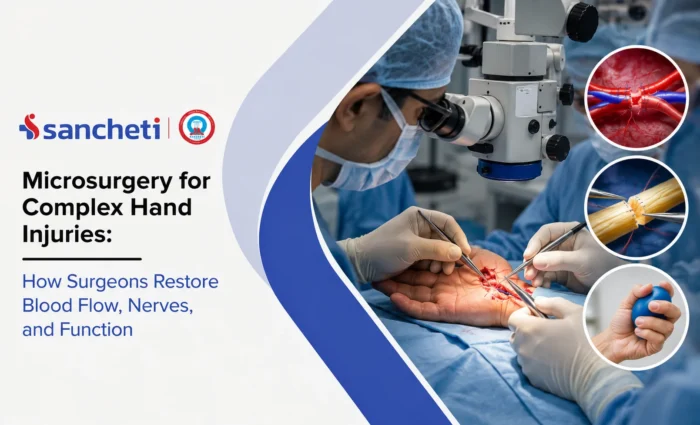

Microsurgery for Complex Hand Injuries: How Surgeons Restore Blood Flow, Nerves, and Function
Microsurgery for hand injuries reconnects structures smaller than a millimetre in diameter – arteries, veins, and nerves – using magnification and instruments designed for work the naked eye simply cannot perform. Specialist centres in Pune and other major Indian cities now offer this level of precision around the clock.
For a hand crushed in machinery or severed in an accident, complex hand injury treatment depends entirely on this precision. This guide explains what actually happens under the microscope, why it takes years of specific training to do well, and what patients can realistically expect from the process.
What is Microsurgery for Hand Injuries?
Microsurgery is a surgical discipline built around the operating microscope, magnifying the surgical field enough to work on structures the human eye cannot resolve unaided. In hand surgery, this means reconnecting blood vessels often under a millimetre in diameter, repairing individual nerve fascicles, and transferring entire blocks of living tissue from one part of the body to another while keeping that tissue alive throughout the move.
The technique exists because the hand’s function depends on structures too small for standard surgical technique to repair reliably. A digital artery supplying a finger, a single nerve fascicle carrying sensation to a fingertip, or the delicate venous network draining a transferred flap all require the stability, magnification, and specialised micro-instruments that only an operating microscope and dedicated microsurgical training can provide, often built over years of focused practice.
Complex Hand Injury Treatment: What Makes an Injury Complex
Not every hand injury needs microsurgery. A simple fracture or a superficial laceration is managed with standard orthopaedic and general surgical technique. An injury becomes complex, and enters microsurgical territory, when it involves several tissue types simultaneously or when blood supply itself has been disrupted, meaning the hand’s survival, not just its appearance, is at stake.
- Complete or partial amputation: a finger, thumb, or hand severed or nearly severed, requiring vascular reconnection to survive.
- Combined injury across multiple structures: bone, tendon, nerve, and blood vessel all damaged together, most common in crush and machinery injuries.
- Large soft tissue loss: skin and underlying tissue missing over a wide area, exposing tendon or bone with no local tissue available to cover it.
- Devascularised tissue: a part of the hand that remains attached but has lost its blood supply, at risk of dying without urgent vascular repair.
How Microvascular Hand Surgery Works
The core technical act in microvascular hand surgery is anastomosis, joining two ends of a blood vessel so blood flows through the repair without leaking or clotting. Performed under magnification of 10 to 40 times, the surgeon places sutures finer than a human hair, often 20 to 30 stitches around the circumference of a single vessel less than a millimetre wide.
Both an artery and at least one vein need to be reconnected for tissue to survive; the artery brings blood in, and the vein drains it back out. A repair that restores arterial inflow without adequate venous drainage causes the tissue to swell and eventually fail, which is why venous repair receives just as much attention as arterial repair, despite veins being technically more delicate to work with due to their thinner walls.
Micro surgical Toolkit: Techniques Used
Different structures in a complex hand injury require different microsurgical techniques, often combined within the same operation to address every damaged layer of tissue.
| Technique | Structure Repaired | Typical Use |
|---|---|---|
| Vascular anastomosis | Arteries and veins | Replantation, revascularisation, free flap blood supply |
| Nerve coaptation | Digital and larger peripheral nerves | Restoring sensation and, where relevant, muscle function |
| Free tissue transfer | Skin, muscle, bone, or combined tissue | Covering large defects with vascularised tissue from elsewhere on the body |
| Toe-to-hand transfer | An entire digit, including bone and joint | Reconstructing a thumb or finger lost beyond simple replantation |
Hand Reconstruction Surgery: Free Flaps and Tissue Transfer
When a hand injury has destroyed too much tissue for direct repair or a skin graft to cover, hand reconstruction surgery turns to free flaps, blocks of tissue transplanted complete with their own blood supply from a donor site elsewhere on the body.
- Radial forearm flap: thin, pliable skin well suited to resurfacing the back of the hand or fingers.
- Anterolateral thigh (ALT) flap: a versatile flap providing generous tissue volume for larger defects, increasingly the workhorse choice for complex hand and forearm coverage.
- Groin flap: a pedicled option that does not require microvascular reconnection, useful when recipient vessels at the injury site are too damaged for anastomosis.
The flap is disconnected entirely from its original blood supply, moved to the hand, and its artery and vein reconnected to vessels at the injury site under the microscope, restoring circulation before the operation is considered complete.
Why First 24 to 48 Hours After Surgery Are Critical
A successfully completed microsurgical repair is not the end of the risk period. Blood clots can form at the anastomosis site in the hours after surgery, threatening the survival of the reattached part or transferred flap precisely when the patient assumes the difficult work is finished.
This is why post-operative monitoring is as protocol-driven as the surgery itself: skin colour, warmth, and capillary refill are checked hourly for the first day or two, since early detection of a failing repair allows the patient to be returned to the operating theatre while the problem is still correctable. At Sancheti Hospital in Pune, this monitoring is carried out by a dedicated team trained specifically to recognise the early signs of vascular compromise, since a delay of even a few hours can be the difference between salvage and failure.
Recovery After Microsurgical Hand Reconstruction
Recovery unfolds over months, tracking both the surgical healing and the much slower pace of nerve regeneration.
| Stage | Timeframe | Focus |
|---|---|---|
| Critical monitoring | 0-3 days | Hourly checks of flap or replant viability; strict limb elevation and warmth |
| Early healing | 1-4 weeks | Splint protects the repair; wound and donor site care |
| Progressive recovery | 1-12 months | Nerve regeneration progresses; hand therapy rebuilds strength and coordination |
| Functional outcome | 12-18 months | Extent of sensation and hand function generally clear by this point |
A physiotherapist trained in hand therapy is involved from the earliest safe point in recovery, since the gains achieved in surgery depend heavily on structured rehabilitation to become usable.
Why Specialist Microsurgical Centres Matter
A review of replantation services from a Level 1 trauma centre in India recorded 77 replantation procedures performed on 63 patients over roughly a year, underscoring how much sustained volume a dedicated centre needs to maintain the skill and around-the-clock readiness this work demands.
Complex hand microsurgery is not something a general surgical unit can offer reliably, since success depends on a trained microsurgical team, appropriate instruments and operating microscopes, and round-the-clock availability for the time-sensitive nature of replantation and flap surgery. Sancheti Hospital’s Hand and Microvascular Department in Pune maintains this dedicated infrastructure specifically to provide consistent, high-quality outcomes for complex hand trauma, rather than treating it as an occasional add-on to general orthopaedic care.
Key Takeaways
- Microsurgery for hand injuries uses an operating microscope and specialised technique to reconnect vessels, nerves, and tissue too small for standard surgical instruments to repair reliably.
- Complex hand injury treatment is needed when multiple structures, bone, tendon, nerve, and blood supply, are damaged together, or when tissue has lost its blood supply entirely.
- Successful microvascular hand surgery requires reconnecting both an artery and at least one vein; venous repair is just as critical as arterial repair, despite receiving less attention in lay explanations.
- Hand reconstruction surgery uses free flaps, tissue transplanted with its own blood supply from elsewhere in the body, to cover defects too large for grafts or direct closure.
- The first 24 to 48 hours after surgery carry the highest risk of failure, which is why intensive monitoring for early signs of vascular compromise is standard practice at every specialist centre.
- For an urgent assessment of a complex hand injury, Sancheti Hospital, Pune provides specialist microsurgical care.
Frequently Asked Questions (FAQs)
Q1. How long does microsurgery for a hand injury typically take?
This varies considerably depending on how many structures need repair and whether a free flap is involved. A single digit replantation might take three to six hours, while complex injuries involving multiple fingers, extensive soft tissue loss, and a free flap for coverage can take eight to twelve hours or longer in a single sitting. The vascular anastomosis itself, joining a single artery or vein, typically takes 20 to 40 minutes when performed by an experienced microsurgeon, but a complex hand injury often requires several such repairs alongside bone fixation, tendon repair, and nerve coaptation, all within the same operation.
Q2. Is microsurgery for hand injuries always successful?
No, and setting realistic expectations is part of proper pre-operative counselling. Success rates vary considerably depending on the mechanism of injury, with sharp, clean injuries having notably better outcomes than crush or avulsion injuries where blood vessels are damaged over a longer segment. Even in well-selected cases, a small proportion of repairs fail in the days after surgery due to blood clot formation at the repair site, which is precisely why intensive post-operative monitoring exists, to catch this early enough to return to surgery and attempt salvage. Patient factors, particularly smoking, also measurably affect success, since nicotine constricts the very blood vessels the surgery depends on.
Q3. What happens if a microsurgical repair fails after surgery?
If signs of vascular compromise are detected during the critical monitoring period, typically reduced warmth, colour change, or delayed capillary refill in the reattached or reconstructed tissue, the standard response is urgent re-exploration in the operating theatre, examining the anastomosis site to identify and correct the problem, most often a blood clot or twisted vessel. Early intervention, within hours of the first warning sign, has a meaningfully better chance of salvaging the repair than waiting to see if the situation improves on its own. If salvage is not possible despite re-exploration, the treatment plan shifts to managing the resulting defect through alternative reconstructive options, which might include a different flap, a graft, or in cases of complete replant failure, a well-managed amputation stump.
Q4. Will my hand look and function normally after microsurgical reconstruction?
Most patients regain substantial, usable hand function after successful microsurgical reconstruction, but the result is rarely indistinguishable from an uninjured hand, particularly after severe, multi-structure trauma. Sensation typically returns gradually over many months as repaired nerves regenerate, and some degree of reduced fine sensory discrimination is common even after a technically excellent nerve repair. Where a free flap has been used for coverage, the transplanted skin often has a different colour, texture, and thickness compared to the surrounding hand, though secondary thinning and contouring procedures can improve this over subsequent surgeries. Joint stiffness in the injured fingers is also common, particularly after prolonged immobilisation or extensive soft tissue damage. Despite these limitations, the functional gain from restoring blood supply, closing wounds, and reconnecting nerves is substantial.
Q5. How soon after a severe hand injury does microsurgery need to happen?
This depends on which specific problem is present. For a completely amputated part with no blood supply at all, surgery is genuinely time-critical, and the sooner blood flow can be restored, the better the tissue’s chance of surviving. For a devascularised but still-attached part of the hand, similarly urgent action is needed, since the tissue is actively at risk of dying without prompt vascular repair. For extensive soft tissue loss that does not involve an immediate blood supply emergency, definitive reconstruction with a free flap is sometimes deliberately delayed by a few days to a week to allow the wound to be thoroughly assessed and cleaned, reducing the risk of infection compromising the eventual reconstruction. Getting to a hospital with a dedicated microsurgical capability as quickly as possible after any severe hand injury remains the single most important action a patient or bystander can take.