Home
Home PG College
 Patient Login
 Sancheti Clinic
 Contact Us
 Download Reports
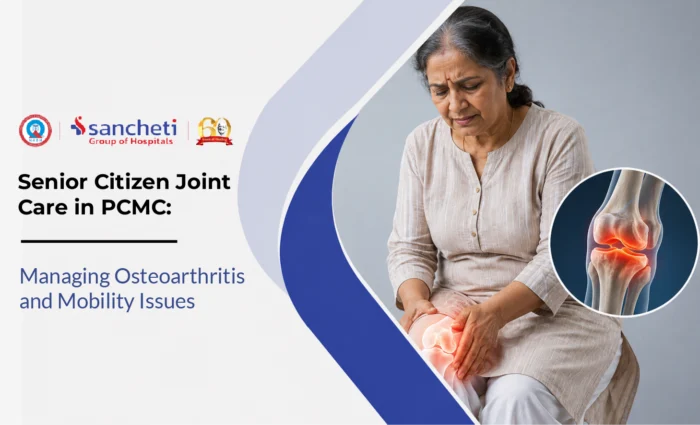

Senior Citizen Joint Care in PCMC: Managing Osteoarthritis and Mobility Issues
Osteoarthritis is the most common cause of mobility problems in older adults, occurring as joint cartilage gradually wears down with age. Pain, stiffness, and reduced flexibility can make walking, climbing stairs, and daily activities difficult. Early treatment with physiotherapy, exercise, weight management, and medication helps maintain independence and improve quality of life.
Sancheti Hospital’s Geriatric Department and orthopaedic teams in Pune address the full picture of senior joint health. This guide covers the conditions, the warning signs, and the management options that matter most for older adults and their families.
What Is Senior Citizen Joint Care?
Senior citizen joint care is a comprehensive approach to preserving mobility, independence, and quality of life in older adults by preventing, diagnosing, and managing age-related musculoskeletal conditions. It extends beyond treating joint pain alone to addressing the underlying factors that influence movement, including muscle strength, bone health, balance, flexibility, and overall physical function. As people age, natural changes such as cartilage wear, reduced bone density, slower tissue healing, and loss of muscle mass increase the risk of arthritis, stiffness, fractures, and falls. These conditions often develop gradually and can affect everyday activities such as walking, climbing stairs, getting up from a chair, or carrying out household tasks.
Senior joint care combines early diagnosis, personalised treatment, physiotherapy, exercise, lifestyle modifications, pain management, and fall prevention strategies to help older adults remain active, reduce disability, and maintain their independence for as long as possible.
Why Joint Health Changes After 60
After 60, the musculoskeletal system faces an accumulation of changes that make joint problems both more likely and more consequential. Cartilage, which has always had limited capacity for self-repair, has had decades to thin and dehydrate. Bone density decreases steadily, making fractures from low-energy falls increasingly common. The muscles that protect joints from abnormal loading weaken with inactivity, and joint pain itself reduces activity, which worsens muscle loss. The cycle reinforces itself.
Hormonal changes in women after menopause accelerate cartilage loss and bone thinning simultaneously. Decades of physically demanding work concentrate this damage in the knees, hips, and lumbar spine. And crucially, joint problems in older adults rarely present in isolation: one painful joint produces compensatory movement patterns that load adjacent joints abnormally, spreading the problem across the lower limb. Managing joint health in a senior citizen means managing this interconnected picture, not treating each joint as a separate problem.
Who Is Most Vulnerable To Osteoarthritis and Mobility Issues
Osteoarthritis affects roughly one in four adults over 55, with prevalence rising steeply with age and women significantly more affected than men after the menopause. But the pattern of joint disease in older adults is shaped by the life they have lived, not just their age.
Former industrial workers, factory floor staff, and construction workers now in their 60s and 70s carry decades of heavy joint loading concentrated in the knees and hips. Overweight older adults face substantially higher rates of knee arthritis, and each additional kilogram of body weight multiplies the compressive force on the knee with every step. Diabetic patients have impaired nerve function, higher infection risk, and altered healing that makes joint disease both more likely and more complicated to manage. A history of joint injury earlier in life, a knee ligament tear, or a fractured ankle from a road accident frequently presents as arthritis in that joint 15 to 20 years later.
Common Joint Conditions in Older Adults
Not all joint pain in older adults is osteoarthritis, and treating the wrong condition as the primary driver produces consistently poor results.
| Condition | Who It Primarily Affects | Key Feature in Older Adults |
|---|---|---|
| Osteoarthritis (OA) | All seniors; knees and hips most common | Activity-related pain; morning stiffness under 30 minutes; grating sensation |
| Gout | Men over 60; women after menopause | Sudden severe pain in one joint; often big toe or ankle; uric acid driven |
| Rheumatoid Arthritis (RA) | Women especially; can worsen significantly in older age | Symmetrical small joint swelling; systemic fatigue; morning stiffness over 60 minutes |
| Calcium Pyrophosphate (CPPD) | Adults over 65; often mistaken for gout or OA | Calcium crystals in joint fluid; acute attacks in knees and wrists |
| Osteoporotic fracture | Women over 65; men over 75 with low bone density | Minor fall causes hip, vertebral, or wrist fracture; sudden severe pain |
Warning Signs That Need Assessment
Joint pain that has settled into a background feature of daily life is easy to underestimate. A few specific patterns suggest that a specialist assessment is the right next step.
- Pain that wakes an elderly person from sleep, particularly in the hip or shoulder: this points to structural joint pathology
- A joint that has swollen for more than two weeks after a fall or minor strain: even if the patient can still bear weight, a fracture in osteoporotic bone must be excluded
- Progressive loss of a specific daily activity over months: stairs that were manageable last year, rising from a low chair, walking to the bathroom at night without holding the wall
- Sudden severe pain in a single joint without any injury: this is the characteristic pattern of acute gout or CPPD, each of which has a specific and highly effective treatment
- Any fall, even without obvious injury: falls in older adults with joint disease frequently cause fractures that are not immediately apparent from symptoms alone
How Senior Joint Problems Are Diagnosed
Assessment of joint pain in older adults requires a different lens than in younger patients. Multiple conditions frequently coexist: osteoarthritis, osteoporosis, and gout are often present simultaneously in the same person. An assessment that confirms degeneration on an X-ray and attributes everything to wear and tear misses treatable conditions.
- Clinical history and examination: gait pattern, balance, joint alignment, range of motion, and a functional assessment of what the patient can and cannot do; the functional picture matters as much as the structural finding
- Blood tests: uric acid for gout; inflammatory markers and anti-CCP for RA; vitamin D and calcium for bone health assessment; these distinguish OA from treatable inflammatory and metabolic conditions
- Weight-bearing X-ray: both knees compared on the same film, patient standing; non-weight-bearing views consistently underestimate the degree of joint space narrowing in OA
- DEXA scan: bone density assessment in elderly patients is often overlooked but directly affects fracture risk management and surgical planning for any joint replacement
Treatment Options Available For Joint Issues
Treatment in PCMC for joint pain in older adults follows the same tiered approach as in younger patients, with two additional priorities: drug safety in a population typically on multiple medications, and maintaining mobility as the overarching outcome measure. Eliminating pain entirely is not always achievable; maintaining function and independence usually is.
- Weight management: the most impactful single intervention for knee and hip OA; even a 5% reduction in body weight produces meaningful improvements in pain and walking capacity in overweight elderly patients
- Analgesics: topical NSAIDs and paracetamol are preferred; oral NSAIDs require gastroprotection and cardiovascular risk review in the elderly; opioids carry significant fall risk and should be used with great caution
- Intra-articular injections: corticosteroid injections for pain flares; hyaluronic acid for longer-lasting benefit in moderate OA; both provide a window in which rehabilitation can be more effective
Staying Mobile: Exercise and Rehabilitation
Mobility in an older adult with joint problems does not maintain itself. It requires deliberate, structured effort: the right exercise, the right equipment, and the right support at home. The most damaging advice a family can receive is that rest is the treatment for arthritic joints. It is not. Inactivity worsens both the joint condition and the muscles that protect it.
A physiotherapist experienced in geriatric rehabilitation designs programmes that are appropriate for the patient’s current capacity: pool walking and gentle cycling for patients with severe joint pain who cannot tolerate land loading; progressive resistance training for quadriceps and hip muscles for those who can. A walking stick used correctly in the hand opposite the painful joint reduces the load through that joint. Occupational therapy adapts the home environment: grab rails, raised toilet seats, appropriate chair heights, and removal of fall hazards. These are not admissions of decline; they are tools that extend independence.
Fall Prevention: Important Precaution For Senior Care
Falls are the most serious acute risk for older adults with joint disease, and also one of the most preventable. A hip fracture in an elderly patient with osteoporosis and poor surgical fitness carries mortality implications that dwarf almost any elective orthopaedic intervention.
- Home hazard assessment: loose rugs, inadequate lighting, bathroom floors without grab rails, and low furniture are the most common fall sites; a systematic room-by-room assessment addresses all of them
- Balance training: specific balance and proprioception exercises reduce fall frequency in older adults independently of strength training; this is a distinct programme, not an extension of the general exercise routine
- Footwear: well-fitted, non-slip footwear with a firm sole significantly reduces fall risk; open-backed slippers worn indoors are one of the most common causes of elderly falls at home
- Osteoporosis treatment: where DEXA confirms significantly reduced bone density, bisphosphonate therapy reduces fracture risk; this is fall prevention at the structural level, reducing the consequence of a fall that still occurs
Key Takeaways
- Joint health in older adults requires a holistic approach that goes beyond simply treating pain.
- Osteoarthritis is common with ageing, but accurate diagnosis by an osteoarthritis doctor in Pimpri Chinchwad is essential as several joint conditions can present similarly.
- Early intervention helps preserve mobility, independence, and overall quality of life.
- A combination of physiotherapy, exercise, weight management, and appropriate medical treatment delivers the best long-term outcomes.
- Staying physically active is crucial, as inactivity accelerates muscle loss and worsens joint problems.
- Fall prevention through balance training, home modifications, and bone health management is a key part of senior orthopaedic care in PCMC.
- Recognising warning signs early and seeking specialist care can prevent complications and improve long-term function.
- Families seeking an elderly joint pain doctor in Pimpri can access the complete senior joint care pathway at Sancheti Hospital, Pune: geriatric assessment, orthopaedic specialist review, joint replacement, and rehabilitation under one roof.
Frequently Asked Questions (FAQs)
Q1. My elderly parents say the joint pain is just old age. When should we insist on a specialist visit in Pune?
The point at which joint pain becomes something to take to a specialist rather than manage at home is when it starts limiting specific daily activities, not just causing discomfort. If your parent can no longer walk to the gate without stopping, cannot climb one flight of stairs without significant pain, is waking at night from joint pain, or has had a fall, these are clinical events that justify a specialist appointment regardless of the patient’s own assessment that this is normal ageing. Many elderly patients have spent so long with their pain that they have recalibrated their sense of what is normal. An X-ray and a clinical assessment frequently reveal treatable Grade 3 or 4 disease that has been accepted for years when it should have been managed. The earlier the assessment, the more non-surgical options are available.
Q2. Is a walking stick appropriate, and does using one make things worse in the long run?
A walking stick used correctly makes things better, not worse. This is a common concern that delays people from using an aid that would meaningfully reduce both pain and joint damage. When used in the hand opposite the painful joint, a correctly sized stick reduces the load through that joint by approximately 25% with every step. Over hundreds of steps a day, that reduction in cumulative loading slows joint damage and reduces pain substantially. The concern that using a stick creates dependence or weakens the leg is not supported by evidence; the muscles continue to function, and the stick is a load-sharing tool rather than a substitute for muscle activity. The stick should be the right height: handle at wrist level when the arm hangs naturally at the side. A physiotherapist can assess and advise on the appropriate aid and teach correct technique in a single session.
Q3. My parent has both knee arthritis and diabetes. Does diabetes make treatment harder?
Diabetes complicates joint care in several specific ways worth understanding clearly. Diabetic patients have a higher rate of joint infections, including septic arthritis, and a painful swollen joint in a diabetic patient that does not behave like a straightforward OA flare warrants infection exclusion. Wound healing after any surgical procedure is significantly impaired in poorly controlled diabetes, making pre-operative blood glucose control to an HbA1c below 8% a standard requirement before joint replacement. Peripheral neuropathy from diabetes can reduce the patient’s ability to report pain levels, making clinical assessment less reliable accurately. And diabetes significantly increases the risk of frozen shoulder, a complication that worsens with inactivity. None of these factors makes treatment impossible, but they do require the treating team to take a more careful, co-ordinated approach rather than managing the joint problem in isolation from the diabetes.
Q4. When should we consider knee or hip replacement for an elderly parent?
The decision for joint replacement in an older adult rests on two conditions being present simultaneously: imaging confirming advanced joint disease on a weight-bearing X-ray, and functional impairment significant enough that the patient cannot live the life they need to live, despite a genuine trial of conservative management. The patient’s own account of their functional limitation is central to this decision, not just the X-ray grade. The concern about age and fitness is valid but manageable: Sancheti Hospital’s Geriatric Department conducts pre-operative assessments specifically for elderly surgical candidates, evaluating cardiac fitness, anaesthetic risk, bone quality, and frailty systematically. Most older adults who can still walk short distances and do not have uncontrolled systemic disease are candidates for assessment. Delaying surgery until a patient becomes completely immobile produces harder recoveries and less complete outcomes than operating while mobility, muscle, and general health are still reasonable.
Q5. How do we keep an elderly parent moving when they are in pain and reluctant to exercise?
This is one of the most practically important questions in senior joint care, and the honest answer is that it requires working with the pain rather than waiting for it to disappear before exercising. Pool walking and hydrotherapy reduce the compressive force on arthritic joints by 50-60% while still allowing the muscles to work: this is often the entry point for elderly patients who find land-based exercise too painful to start. Short, frequent movement is more tolerable and less damaging than one longer session: ten minutes of walking three times a day is better for both joints and motivation than thirty minutes once. Analgesics taken before exercise, timed to reach peak effect when the session begins, reduce the pain enough to allow movement that would otherwise be avoided. A physiotherapist experienced in elderly rehabilitation can build a programme that starts at the patient’s actual current capacity and advances incrementally, which produces far better adherence than a generic exercise sheet.